
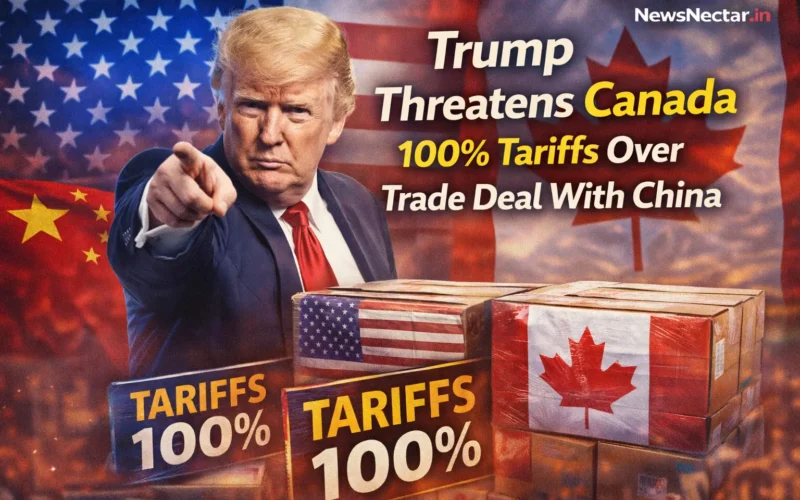
Trump Threatens Canada: Why the Latest Trade Warning Has Shaken Markets
Former US President Donald Trump has reignited global trade tensions after issuing a stark warning that the United States could impose 100% tariffs on Canadian goods. The dramatic escalation came after reports that Canada is deepening its trade engagement with China, a move Trump claims undermines American economic and strategic interests.
The statement has triggered sharp reactions across North America, with policymakers, businesses, and investors assessing the potential fallout as Trump threatens Canada at a time when global trade relations are already fragile.
What Did Trump Say? A Breakdown of the Threat
In remarks that quickly went viral, Trump said that if Canada continues to pursue what he described as “unfair and dangerous trade arrangements with China,” the US would respond with tariffs as high as 100% on selected Canadian imports.
According to Trump:
-
Canada is “taking advantage” of US market access
-
Trade with China creates national security risks
-
Tariffs are necessary to “protect American workers”
This is not the first time Trump threatens Canada, but the scale of the proposed tariffs marks a significant escalation compared to past disputes.
Why Canada’s Trade Deal With China Matters
Canada has been gradually expanding economic engagement with China in areas such as:
-
Agricultural exports
-
Critical minerals
-
Manufacturing supply chains
-
Clean energy technologies
From Washington’s perspective, particularly under Trump’s worldview, such engagement weakens Western economic unity against Beijing.
Trade and investment data involving China are tracked by the World Trade Organization (WTO)
👉 DoFollow source: https://www.wto.org
As Trump threatens Canada, the warning also reflects broader US anxiety over China’s growing influence in global supply chains.
Trump Threatens Canada: Echoes of the Trade War Era
For many observers, the rhetoric brings back memories of the US–China trade war launched during Trump’s presidency. That period was marked by:
-
Tit-for-tat tariffs
-
Supply chain disruptions
-
Increased costs for consumers
-
Heightened market volatility
Analysts say the latest episode where Trump threatens Canada signals that trade confrontation could once again become a core policy tool if Trump regains political power.
Canada’s Response: Calm but Firm
Canadian officials responded cautiously, emphasising:
-
Canada’s right to pursue independent trade policy
-
Commitment to fair and rules-based trade
-
Importance of North American economic integration
While Ottawa avoided direct confrontation, sources indicated that Canada is preparing contingency plans should Trump threatens Canada translate into actual policy.
Canada’s trade framework is governed by agreements like USMCA, details of which are available via the Government of Canada
👉 DoFollow source: https://www.international.gc.ca
Why 100% Tariffs Would Be Economically Disruptive
A 100% tariff would effectively double the cost of targeted Canadian goods entering the US market.
Sectors at Risk
-
Automobiles and auto components
-
Agricultural products
-
Steel and aluminium
-
Energy-related exports
Economists warn that if Trump threatens Canada becomes policy, the damage would not be one-sided. US manufacturers and consumers would also face:
-
Higher input costs
-
Supply disruptions
-
Inflationary pressure
Impact on Global Markets and Investor Sentiment
Financial markets reacted nervously to headlines that Trump threatens Canada, with analysts warning of:
-
Increased trade uncertainty
-
Higher risk premiums
-
Volatility in commodity-linked currencies
Trade uncertainty indicators tracked by the International Monetary Fund (IMF) show that protectionist rhetoric often weighs on global growth
👉 DoFollow source: https://www.imf.org
China’s Position: Strategic Silence, Economic Leverage
China has not directly responded to Trump’s comments, but analysts note that Beijing is likely to:
-
Continue diversifying trade partners
-
Leverage Canada’s resource base
-
Avoid public escalation
From China’s perspective, the fact that Trump threatens Canada underscores fractures within Western economic alliances — a strategic opportunity Beijing has historically exploited.
Geopolitical Angle: More Than Just Trade
Experts argue that Trump threatens Canada is not merely an economic move but part of a broader geopolitical narrative.
Key Strategic Drivers
-
US-China rivalry
-
Technology and supply chain security
-
Control over critical minerals
-
Influence in North America
Trade policy, in this context, becomes a tool of strategic pressure rather than simple economic negotiation.
Historical Context: US–Canada Trade Disputes
Despite being close allies, the US and Canada have a long history of trade friction:
-
Softwood lumber disputes
-
Steel and aluminium tariffs
-
Dairy market access issues
However, a threat of 100% tariffs marks one of the most extreme positions taken in recent decades, highlighting how unusual it is when Trump threatens Canada at this scale.
What Happens If Trump Returns to Power?
Markets and governments are increasingly factoring in the possibility of Trump returning to office. If that happens:
-
Tariff threats could quickly become executive action
-
Trade agreements may face renegotiation
-
Protectionism could intensify
This makes the current episode where Trump threatens Canada more than campaign rhetoric — it is a signal of potential policy direction.
Business Reaction: Uncertainty Hurts Planning
North American businesses rely heavily on integrated supply chains. Executives warn that repeated episodes where Trump threatens Canada:
-
Disrupt investment decisions
-
Delay capital expenditure
-
Increase hedging and compliance costs
Industry groups in both countries are urging policymakers to avoid escalation.
Could This Trigger Retaliation From Canada?
Trade experts say Canada has several options if tariffs are imposed:
-
Retaliatory tariffs on US goods
-
WTO dispute settlement
-
Diversification away from US markets
However, retaliation risks escalating the conflict further — something Canada historically tries to avoid even when Trump threatens Canada.
Broader Implications for Global Trade Order
The episode raises concerns about the stability of the global trade system. Frequent unilateral tariff threats undermine:
-
WTO frameworks
-
Investor confidence
-
Long-term trade planning
If major economies resort to tariffs as political tools, the world could see a return to fragmented trade blocs.
Expert Opinion: Pressure Tactic or Policy Signal?
Most analysts believe the move is:
-
A pressure tactic aimed at influencing Canada’s China policy
-
A campaign signal to domestic voters
-
A warning to allies about aligning too closely with Beijing
Still, history suggests that when Trump threatens Canada, follow-through cannot be ruled out.
Key Takeaways
-
Trump threatens Canada with 100% tariffs
-
Warning linked to Canada’s trade engagement with China
-
Potential fallout for North American supply chains
-
Markets uneasy amid protectionist rhetoric
-
Broader geopolitical implications beyond trade
Conclusion: Trump Threatens Canada, Raising Stakes for Global Trade
The latest episode where Trump threatens Canada highlights how trade policy is once again becoming a frontline geopolitical weapon. While no tariffs have been imposed yet, the warning alone has introduced uncertainty into global markets and diplomatic calculations.
Whether this threat remains rhetoric or evolves into policy will depend on political outcomes in the US. For now, the message is clear: trade relations in the Trump era are unlikely to prioritise predictability, and allies as well as rivals may find themselves in the crosshairs.